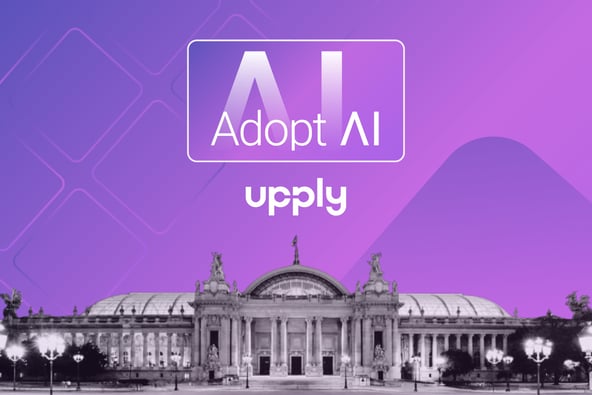
Two weeks ago, Upply was at the Grand Palais for Adopt AI, a European event dedicated to the adoption of artificial intelligence by businesses. With more than 25,000 participants and 500 speakers, Adopt AI shared a clear message: AI is no longer an R&D topic, but a major economic issue, reshaping business models, roles and value chains.
In this dynamic environment, transport and supply chain naturally stood out. Few sectors combine such a high level of operational complexity, cost pressure, market volatility and data intensity — if any, it is ours.
A data-rich sector, still far from unlocking the full potential of AI
On stage, alongside Marie-Christine Lombard, CEO of Geodis, a global leader in transport and logistics, Thomas Larrieu, CEO of Upply, first put things into perspective: the supply chain represents a significant share of the economy (around 10% of global GDP), yet it remains largely invisible, as long as flows run smoothly.
In this context, the challenges faced by the sector are well known. The issue is not the lack of data, but the ability to use it at scale. In most organisations:
-
data exists, but it is fragmented,
-
sources are multiple and rarely standardised,
-
processes remain highly manual,
-
and the market evolves faster than the tools designed to monitor it.
As a result, the supply chain has never had so much data... and yet decision-making has never been so complex.
AI as a simplification accelerator
One key takeaway from the discussions at Adopt AI is that artificial intelligence is not seen as an abstract technological breakthrough, but as a practical way to address very concrete challenges:
-
structuring what is fragmented,
-
detecting what is barely visible — or not visible at all,
-
automating what takes too much time,
-
explaining what is not intuitively readable.
In transport, the challenges are clear: large volumes of data, complex flows to synchronise, and decisions that must be made continuously. AI helps structure information more effectively, identify signals that are difficult to detect manually, and reduce the time spent consolidating or interpreting data. The goal is not to replace domain expertise, but to support it, by bringing greater clarity to a complex environment.
An environment that accelerates AI adoption
1. Market volatility makes continuous analysis essential
Cycles that once unfolded on a quarterly basis are now measured week by week — sometimes day by day. Available capacity, fuel prices, geopolitical tensions, port congestion: everything moves faster.
AI helps absorb this pace by continuously analysing market signals, where traditional approaches struggle to keep up.
2. Globalised — and more fragile — supply chains
The supply chain has become a global, interconnected network, where a local incident can have repercussions on the other side of the world. Historical models built on averages and stable assumptions are reaching their limits.
AI helps better understand these interdependencies: it identifies correlations, simulates scenarios, and highlights risks that would be nearly impossible to detect manually.
3. Increasing pressure on margins
Rising operating costs, demand volatility and growing competition are reducing the room for manoeuvre for transport players. In this context, access to the right information at the right time becomes a decisive competitive advantage:
-
optimising transport plans,
-
adjusting pricing strategies,
-
arbitrating between different capacity scenarios.
Here again, AI plays a key role by turning raw data into informed decisions.
4. A growing demand for simplicity from users
In an increasingly complex environment, teams are looking for tools that are easy to use and integrate seamlessly into their daily workflows, without multiplying interfaces. More direct, question-and-answer-based approaches respond well to this expectation.
5. Transport decarbonisation becomes unavoidable
Last but not least: environmental pressure. Between European emissions reduction targets, regulations (Fit for 55, CSRD, national frameworks), and growing expectations from shippers and consumers, transport is at the forefront.
AI provides several concrete levers:
-
better measurement of emissions across the entire chain,
-
simulation of the impact of different modes, routes or partners,
-
optimisation of load factors and reduction of empty miles,
-
support in arbitrating between cost, lead time and carbon footprint.
In other words, AI is not only about economic performance — it is also becoming a tool to manage environmental performance and support the transition towards more sustainable logistics.
Towards a new generation of decision-making in transport
One message consistently emerged from the discussions: artificial intelligence only creates value if it improves decision-making. The objective is not to add another layer of technology, but to enable professionals to work with clearer, more reliable information.
This is the approach behind Upply’s solutions — with the ambition to support transport players in their day-to-day decisions, whether strategic or operational.
Atlas: a market intelligence agent built on Upply's data
In this context, Upply has launched Atlas, a market intelligence agent dedicated to transport and supply chain.
What distinguishes Atlas from a general-purpose tool like ChatGPT is the quality of its sources. Atlas is not built on broad, generic web knowledge, but on a foundation of transport-specific sources, selected for their reliability and relevance. It draws in particular on Upply’s proprietary data (Market Insights and monthly barometers — maritime, air, road France — economic studies and analyses, Upply Freight Index), as well as qualified external sources (specialised transport reports, industry media, public data and open data).
The objective is simple: deliver answers that are genuinely useful for professionals. In practice:
-
you ask a question in natural language,
-
Atlas provides a clear, contextualised response,
-
with market-oriented insights: trends, signals, price movements, macro analysis.
Want to learn more about Atlas? Discover it here.
Artificial intelligence is gradually becoming a central topic for the transport sector. Not as an end in itself, but as a means to address very concrete challenges: visibility, performance, resilience and environmental impact reduction. The discussions at Adopt AI highlight one thing clearly: the sector is ready to move to the next stage: provided it relies on real use cases, reliable data and tools designed for professionals.
Go further: download the white paper on concrete AI use cases in transport
Upply has gathered in a white paper a set of examples directly applicable to the supply chain: market analysis, decision support, performance and decarbonisation. Discover how AI is already being integrated, pragmatically, into industry practices.