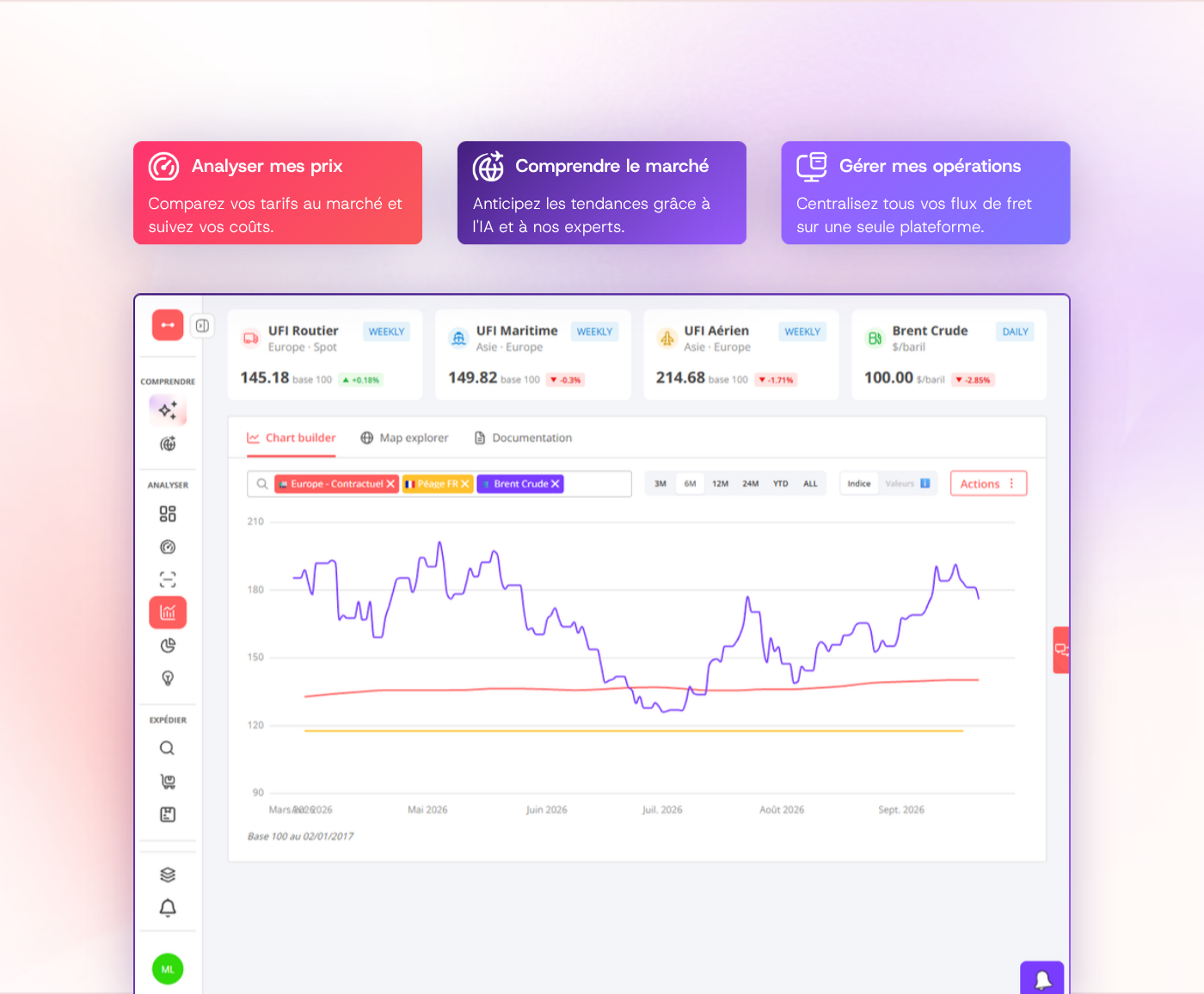
Ready to manage your road transport with more visibility?
With Upply, shippers, carriers and consulting firms can:
-
Track road freight indices
-
Compare their rates with market prices
-
Understand corridor trends and the factors driving them

The right truck depends on the volume, the distance and the type of goods.
Articulated vehicle (tractor + semi-trailer): the dominant configuration for long distances, up to 44 t. It accounts for 87% of tonne-kilometers in France.
Rigid truck: a single-unit truck with no trailer, used for regional and urban trips (19 to 32 t depending on the axles).
Road train: a rigid truck towing a trailer, for more specific uses.
The body is adapted to the goods: curtainsider (pallets, the most versatile), refrigerated (temperature-controlled), flatbed (heavy or oversized loads), tanker (liquids), tipper (bulk) or box van (parcels, urban deliveries).
Road freight activity is measured in tonne-kilometers: one ton carried over one kilometer.
Source: IRU
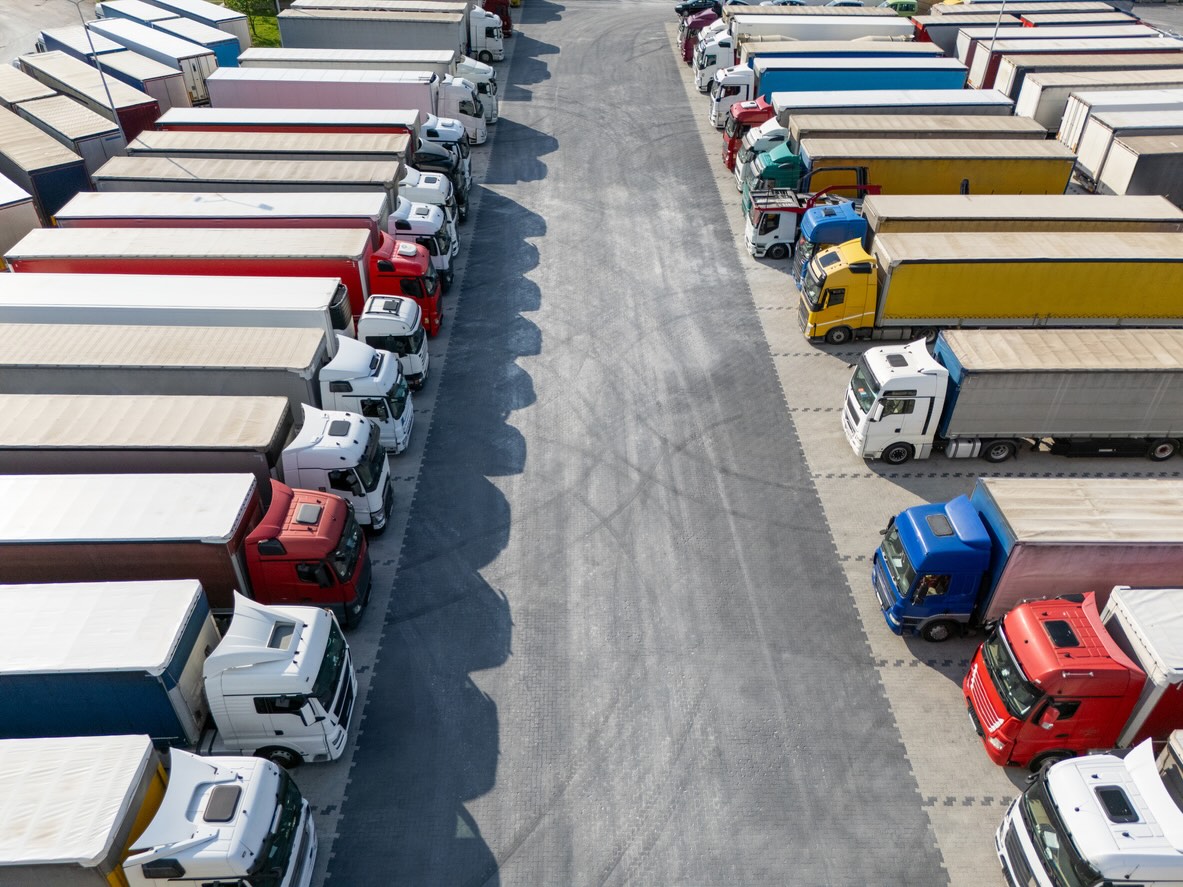
The French heavy-truck fleet was still 96.9% diesel in early 2025. Alternative powertrains are gaining ground, though: in 2025, 12.5% of new trucks over 3.5 t ran on natural gas or electricity, according to the IRU.
This transition comes at a cost: an electric truck remains much more expensive to buy than a diesel one, which weighs on transport prices.

Logistics hubs act as the interface between long-distance flows and local distribution. They gather goods from several origins, then consolidate or redistribute them to their final destinations.
The largest are located near major ports, airports or industrial areas. They make it possible to combine road with rail, inland waterways or ocean shipping.


Germany is the heart of the European road network: in 2025, 9 of the top 20 intra-European routes by tonnage started or ended there, according to Upply Market Insights. The largest corridors by volume are:
Germany–France: down 6.3% in 2025
Spain–France: down 5.1%
Germany–Poland: stable
Germany–Netherlands: down 3.4%
The center of gravity is shifting east, however. Corridors linked to the Czech Republic are growing fast: Czech Republic–Germany (+30.3%), Czech Republic–Slovakia (+27.9%) and Czech Republic–Poland (+26.1%). This trend reflects economic growth in Eastern Europe and the competitiveness of its carriers.
To track spot and contract rate trends on the main corridors, read our quarterly European road freight rates benchmark, produced with Ti Insights and the IRU.


Nearshoring means relocating production or sourcing to countries close to the end market. It differs from reshoring (bringing activity back to the home country) and friendshoring (relocating to allied countries).
The pandemic, the war in Ukraine, trade tensions with China and rising long-distance transport costs have exposed the fragility of global supply chains. Many European importers are turning to closer suppliers in Eastern Europe, Turkey or Morocco.
More intra-European flows: east-west corridors (Poland, Romania, Bulgaria) and routes to Turkey or Morocco are growing, as are Central European hubs.
Networks to rebuild: new routes, new hubs and contracts to renegotiate, bringing opportunities but also transition costs for carriers.
A trend still uncertain: in 2025, many companies postponed their projects while waiting for a clearer trade environment.
In the medium term, the EU's drive to build European value chains (batteries, semiconductors, pharmaceuticals, automotive) should generate additional road freight flows.
Ready to manage your road transport with more visibility?
With Upply, shippers, carriers and consulting firms can:
Track road freight indices
Compare their rates with market prices
Understand corridor trends and the factors driving them