The annual contract, signed once a year at a fixed price, is showing its limits in containerized ocean freight.
During our webinar on November 3, 2026, dedicated to the 2026-2027 tender season, our experts highlighted a trend that is gaining momentum: mini-tenders launched in the course of an annual contract.
What is an ocean freight mini-tender?
An ocean freight mini-tender is a simplified process for putting ocean carriers (shipping lines or NVOCCs) in competition, used by shippers to obtain freight rates on a limited scope. Rather than waiting for the next tender season, the shipper re-tenders part of its volumes during the annual contract.
Why mini-tenders are becoming more common
A shift in contractual relationships
The single-price annual contract is increasingly seen as static, including by shippers. The spot market is used more and more. As a result, other formats are gaining ground in the contractual relationship, such as the 6+6 contract or the indexed contract.
Rates that move fast, and not in the same direction
In 2026, the main trade lanes followed different paths. The gap between the Asia-Europe corridor and the Transpacific, for example, reached historic levels. A rate negotiated at the start of a contract can therefore quickly drift away from the market.
Disruptions have become frequent
Diversions via the Cape of Good Hope, transit restrictions through the Panama Canal, the typhoon season in Asia, armed conflicts: when a major disruption hits the market, shippers want to be able to shift their freight more easily.
When should you launch a mini-tender?
For the 2026-2027 season, we at Upply believe that a decline in freight rates is likely. Four signals are worth following closely:
- Capacity growth: many new vessels will enter service in 2026 and 2027.
- The gradual return to the Suez Canal: it increases the capacity available on the Asia-Europe corridor.
- MSC's strategy: the market leader can set the tempo, depending on whether it prioritizes market share or profitability in 2027.
- Disruptions: extreme weather, conflicts and congestion can slow the erosion of rates.
Our figures and our analysis for each of these signals are available in our white paper.
On which lanes?
Negotiations always start from the existing situation. In 2026, however, each major trade lane followed its own path, according to the Upply Freight Index (UFI):
- Asia-Europe : rates are down sharply from their July peak. The market is under pressure without collapsing, and carriers are struggling to push through general rate increases.
- Asia-North America West Coast: rates have risen over 12 months and returned to their June record level, driven by carriers’ capacity discipline and strong demand.
- Transatlantic: the market remains relatively stable over time, with slight overcapacity. Rates could rise as the pre-holiday peak season approaches.
With such gaps, tracking your rates line by line becomes essential. UFI indices can be accessed in the Upply Data Hub.
How to manage a mini-tender: the right tools make the difference
The approach is surgical: mini-tenders are much simpler to manage with the right tool. Done by hand, they represent an enormous process and a heavy workload.
Thanks to more autonomous procurement tools, combined with reliable market data, the burden of managing tenders has been significantly reduced. To manage them, you can rely on different modules such as those of the Upply platform :
-
Benchmark: track your lanes, analyze your ocean freight spend and compare your rates to the market.
-
Data Hub: access ocean freight indices and key public data, such as fuel and inflation.
-
Atlas : ask your market questions in natural language and put the analyses of your own lanes in context.
-
Market Insights: draw your analysis on expert studies and monthly barometers.
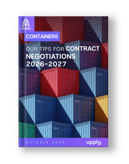 Preparing your 2026-2027 tenders?
Our white paper gives you our complete analysis framework for the season: supply and demand, fuel, choice of channel, Incoterm and timing.
Download our white paper
Other factors of flexibility
Mini-tenders are one of the levers of flexibility this season. Contract length is another, as is the choice of channel: going through an NVOCC rather than directly with a carrier can offer greater contractual flexibility.
Preparing your tenders? Find our experts’ answers to the main questions shippers are asking about the 2026-2027 season.
To go further