What is an ocean freight rate?
The ocean freight rate is the price charged for transporting goods by sea, expressed per container (TEU for a 20', FEU for a 40') or per tonne for bulk cargo. It covers the port-to-port leg: pre- and on-carriage, as well as part of the ancillary fees, are generally excluded.
The market is concentrated around a handful of major shipping lines and alliances. Their decisions on capacity, frequency and service organization directly influence the supply available on the main trade lanes.
Why do ocean freight prices change?
Ocean transport is subject to strong price volatility, driven by several factors:
-
Operating costs (fuel, crew wages, vessel investment, insurance): the floor below which carriers cannot operate sustainably
-
Supply/demand balance: the factor that exerts the strongest pressure on prices, with rates collapsing under overcapacity and spiking under capacity shortages
-
The economic cycle: ocean transport is a barometer of the global economy
-
Exogenous events: health crises, geopolitical conflicts, and climate hazards
Digitalization and data science now make it possible to better anticipate freight price volatility and improve pricing visibility.

What are the main drivers of rate evolutions?
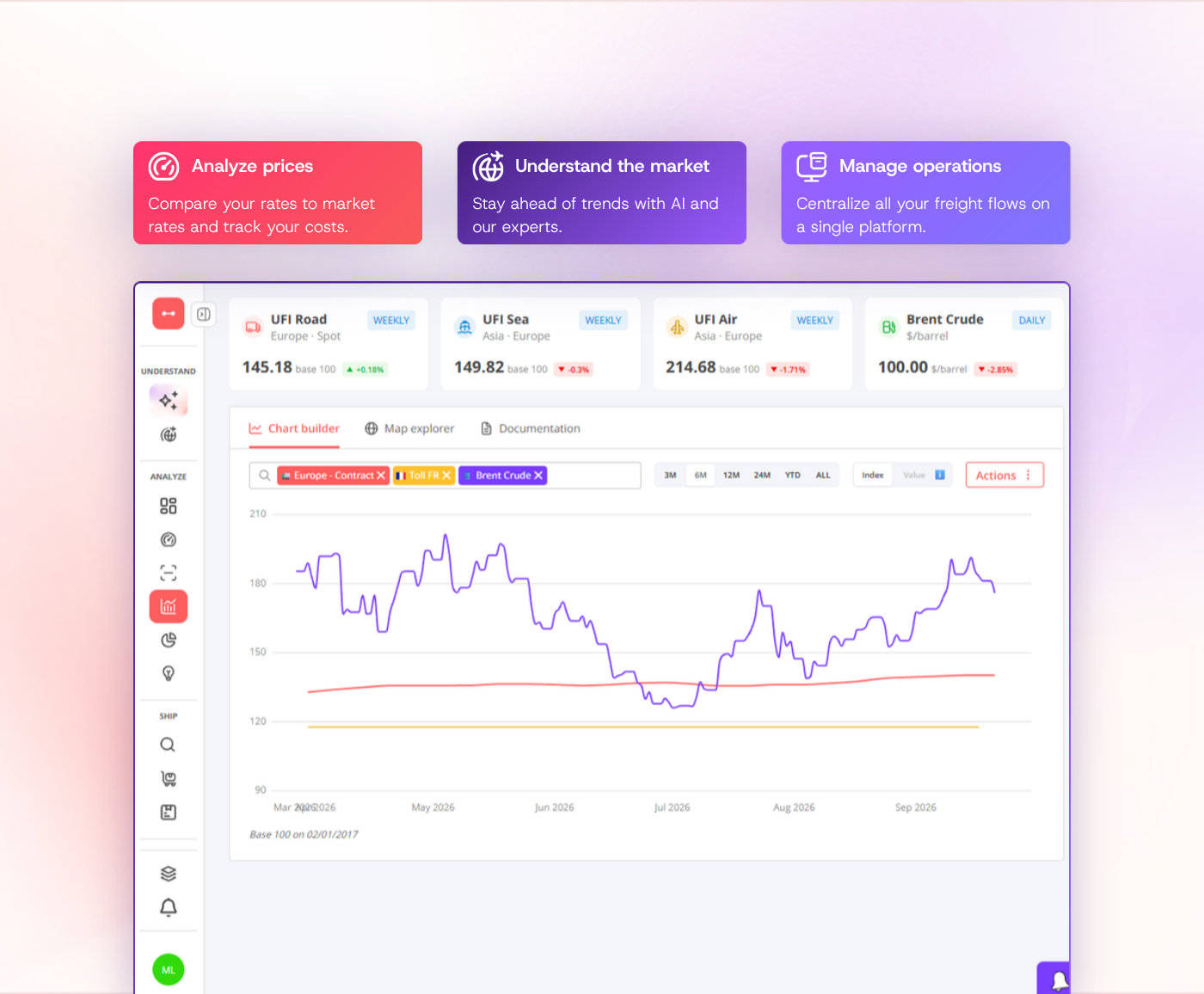
Several of these factors are tracked in the Data Hub, Upply’s interface that aggregates freight indices and indicators related to energy, economic activity, and transportation markets.
-
Available capacity: the wave of new vessel orders placed after Covid created structural overcapacity, weighing on rates since 2023
-
Market concentration: the dominance of a handful of alliances gives them significant pricing power through capacity management (blank sailings, slow steaming)
-
Energy transition: regulatory obligations are pushing up fixed costs, with a growing trend toward green surcharges
-
Geopolitics: the Red Sea crisis and the resulting Cape of Good Hope detour have mechanically reduced available capacity, putting upward pressure on rates
-
Trade policy: the 2025 U.S. tariffs triggered massive order front-loading, creating unusual fluctuations in demand throughout the year
-
Peak seasons: the pre-Christmas and pre-Golden Week periods generate regular demand surges
-
Port congestion: the backlog of ships and containers in ports reduces available capacity and disrupts rotations
The value of the goods being shipped plays a key role: a 3x to 4x rate increase weighs far more heavily on low-value goods (chemicals, basic food commodities) than on high-tech products.
Long-term contracts
Budget stability, but less flexibility and the risk of overpaying when rates soften.
FAK rate (Freight All Kinds)
Full flexibility, but complete exposure to market volatility.
Learn more on FAK rates
CBR (Commodity Box Rates)
A historical pricing model with rates differentiated by cargo type, sometimes floated as a possible comeback during rate spikes.
Lear more on CBR

Premium programs
Priority loading guaranteed by the carrier in exchange for volume commitments, useful during periods of capacity tension.
What additional fees can come on top of the base rate?
Beyond the base freight rate, several surcharges are commonly added to the invoice. The most common are BAF, CAF, and THC. More specific surcharges also apply: ISPS (port security), MARPOL (environmental compliance), LSF (low sulfur fuel), EBS (emergency bunker surcharge), and the Aden surcharge (piracy risk in the Gulf of Aden).
General average: an often overlooked cost
Beyond surcharges, shippers face a major financial risk that is often underestimated: general average. This international maritime law mechanism provides that, in the event of an incident at sea, all parties (the carrier and the cargo owners) share the losses and expenses incurred to save the vessel.
How to protect against it: appropriate cargo insurance can cover the call for contribution in the event of general average. However, the scope of this coverage depends on the policy purchased and should be verified with the insurer or broker.
-
Blend spot and contract rates: combine a base volume covered by long-term contracts with a spot portion to keep flexibility
-
Plan annual negotiations ahead of time: contract renewals are often decided during slack periods, when the balance of power favors shippers
-
Use FAK rates selectively, for one-off or urgent shipments
- Optimize container fill rates: cost per m³ or per pallet is the real measure of logistics performance
- Favor merchant haulage over carrier haulage for pre- and on-carriage, where possible
-
Rely on market price benchmarking tools to back up negotiations during tenders and avoid overpaying
How does ocean freight compare to road, rail and air?
On a long-haul lane such as Shanghai to Paris, here is an order-of-magnitude comparison of transit times and relative costs by mode, benchmarked against ocean freight:
-
Ocean FCL + road (Le Havre to Paris): around 50 days transit, cost baseline
-
Rail FCL: around 25 days transit, roughly twice as expensive as ocean
-
Road: around 15 days transit, roughly 4 to 5 times more expensive than ocean
-
Air: around 8 to 10 days transit, significantly more expensive, reserved for high-value shipments
These figures are indicative and change continuously with the market. For an up-to-date comparison on your key lanes, use Upply Benchmark.

Ready to optimize your ocean freight costs?
With Upply, the intelligent transport management platform, shippers, carriers, and consulting firms:
-
Benchmark their ocean freight rates (spot and contractual) against real market prices
-
Centralize their transport data to manage costs and renegotiate contracts with full visibility
-
Track price drivers from a single interface