The fuel share of operating costs in road freight transport is expected to rebound very sharply in 2027, due to the surge in diesel prices in 2026.
This figure could weigh heavily in 2027 negotiations: at the start of each year, the French National Road Committee (CNR) updates the fuel share in the operating costs of a road transport operation, by type of activity. This weighting serves as the reference for calculating diesel indexation on millions of invoices.
In 2026, the diesel share for a long-distance articulated truck had fallen to 20.9%, its lowest level in ten years, as diesel prices eased the previous year. But with the new spike in fuel prices in 2026, this share is expected to rebound very significantly. According to Upply's estimates, it should be between 27% and 28.5% in 2027, and could reach 29% if diesel returned to its October level.
1. CNR diesel index: a record 288 points in 2026
2026 will go down as a record year for professional diesel. With the Middle East crisis that broke out in late February, the CNR professional diesel index (vehicles of 7.5 t and over, base 100 in December 2000) soared. Starting at 181.5 in December 2025, it reached 288.1 in October 2026, an increase of 58.7% in ten months. In response to the volatility, the CNR even began publishing its indices twice a month from March, in addition to the monthly index, which remains the reference.
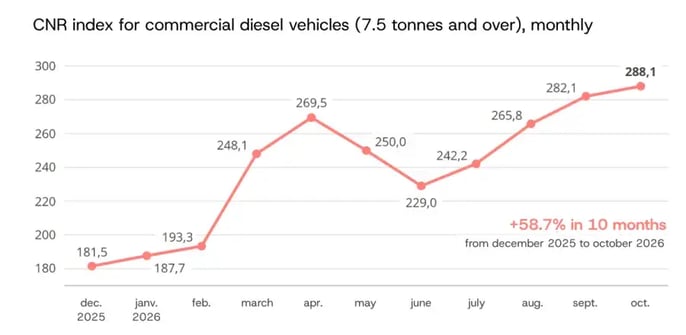
CNR professional diesel index, 7.5 t and over. Source: CNR.
The shock doesn't stop at fuel. According to the CNR, the cost price of a long-distance diesel heavy goods vehicle rose by 8.8% on average in 2026. A factor to take into account as shippers and carriers wrap up their annual negotiations.
2. Diesel indexation: the parameters to consider
To understand what's at stake, we need to go back to the mechanism. In France, diesel indexation is mandatory (articles L3222-1 and L3222-2 of the French Transport Code). The price of a transport must track changes in fuel costs between the contract date and the transport date. If the contract says nothing, the CNR indices and weightings apply (CNR user guide).
The calculation fits on one line:
Indexation = fuel share × (index for the month of transport / reference index − 1)
There are therefore two ingredients to consider:
- The CNR monthly index, which tracks the price of professional diesel and changes every month.
- The fuel share, which measures the weight of diesel in the total cost of transport. It is this second parameter, much less closely watched, that is set to change scale in 2027.
The CNR calculates the fuel share based on economic conditions in December of the previous year: the 2026 share therefore reflects diesel prices in December 2025, which were then at their lowest. For long-distance articulated trucks, it stood at 20.9%, down from 26.5% in 2023.
The choice of December matters. In 2026, diesel rose by 36.4% on an annual average basis, but by 58.7% between December 2025 and October 2026. If the 2027 share were calculated on the annual average, it would increase far less.
Good to know: the fuel share set in the original contract does not change when the new CNR value is published. However, the DGITM-DGCCRF guide of November 2026 states that if it no longer reflects the economic reality of the transport, it should be updated, and that a clearly underestimated share may be deemed unlawful. With a gap from 20.9% to around 28%, the question will arise for many contracts in 2027.
This guide, published by the DGITM (French Directorate General for Infrastructure, Transport and Mobility) and the DGCCRF (French consumer protection and fraud authority), also points out that the scheme is a matter of public policy: a non-compliant clause automatically defaults to the CNR indices and weightings, and a shipper who fails to comply faces a €15,000 fine. (source)
3. What fuel share to expect in 2027?
In response to customer demand, Upply has calculated an estimate of how the fuel share might evolve, which of course remains indicative. We applied the CNR method, which consists of moving each cost item forward from December and then bringing the total back to 100% (CNR, estimating weightings), based on different diesel price scenarios.
| Diesel Index in December 2026 |
Estimated long-distance share for 2027 |
| Around 262 (about 9% below the October level) |
Around 27% |
| Around 280 |
Around 28.5% |
| Around 288 (October level) |
Around 29% |
According to our estimates, the 2027 long-distance share would therefore be between 27% and 28.5%, and could reach 29% if diesel returned to its October level. This would be unprecedented in the recent series, whose peak dates back to 2023 (26.5%), when the outbreak of the war in Ukraine had sent fuel costs soaring the previous year.
In 2027, diesel is thus expected to account for more than a quarter of the cost of a long-distance transport.
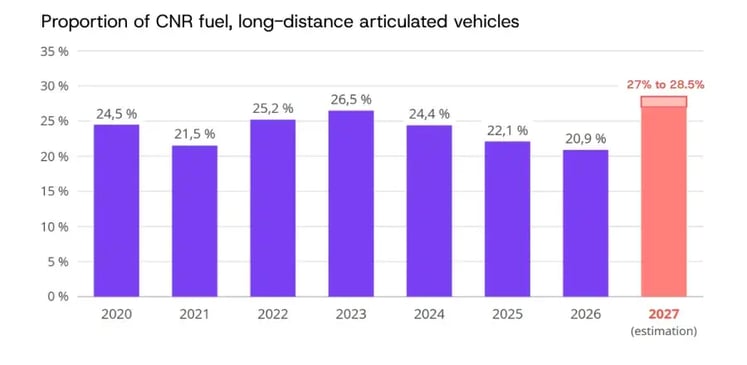
Fuel share in the costs of a long-distance articulated truck (CNR weighting), 2020-2026, and Upply estimate for 2027. Sources: CNR, history of TRM 2026 index weightings, Upply (author’s calculations).
Early November data point towards the lower end of the range. According to the Upply Data Hub, diesel excluding VAT fell from around €1.95/l in October to €1.77/l in mid-November, a 9% drop, following the release of strategic reserves. At this level, the CNR index would be around 255 and the 2027 share around 27%. Everything will therefore be decided in December.
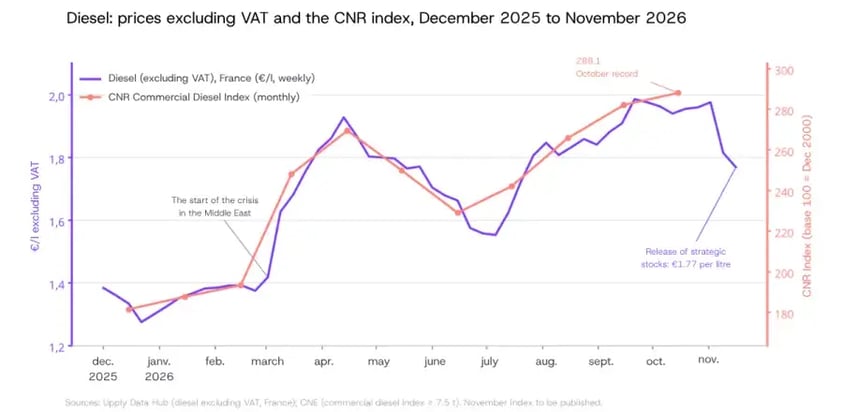
Diesel price excluding VAT in France (weekly) and CNR professional diesel index (monthly). Sources: Upply Data Hub, CNR.
No segment would be spared. With diesel at its October level, the share would rise from 19.2% to around 27% for regional articulated trucks, and from 16.3% to around 23% for regional rigid trucks.
These figures remain estimates. The CNR's new annual survey may change consumption figures or the cost structure, and only the official publication will be authoritative. Also worth noting: non-fuel costs are expected to rise by 4.1% in 2027 according to the CNR, driven by wages.
4. Worked example: a €1,000 transport negotiated on 1 September 2026
Let's take a concrete case. A shipper and a carrier agree on 1 September 2026 on a long-distance transport at €1,000 excl. VAT, using the CNR weighting. The latest published index is then August's, 265.8: this serves as the reference. The fuel share used is the 2026 figure, 20.9%, which represents €209 of fuel in the price.
| Month of transport |
Index |
Calculation |
Invoice adjustment |
| September 2026 |
282.1 |
20.9% × 6.13% = +1.28% |
+€12.80 |
| October 2026 |
288.1 |
20.9% × 8.39% = +1.75% |
+€17.50 |
| Scenario: drop to 250 |
250.0 |
20.9% × −5.94% = −1.24% |
-€12.40 |
In January 2027, as long as the contract is not renegotiated, nothing changes: same price, same reference, same 20.9% share. Publication of the new weighting would have no effect on this contract.
At renegotiation, however, everything would be updated at once: a new price reflecting current diesel prices (€1,017.50 if the index stays at 288) and the increase in other costs, a new reference index, and the new share, which we expect to be between 27% and 28.5%.
5. Double counting: the mistake to avoid when renegotiating in 2027
This is where the main pitfall lies. The new share is not added on top of indexation: it reflects expensive diesel, and should therefore only apply to a price and reference index that were themselves set with expensive diesel.
In our example, with diesel staying at 288 and a 2027 share of 28% (excluding the rise in other costs):
| Situation |
Calculation |
Invoice |
| September contract, not renegotiated |
1,000 × 20.9% × 8.39% |
€1,017.50 |
| Renegotiated contract (price €1,017.50, reference 288, share 28%) |
stable diesel: +€0 |
€1,017.50 |
| Mistake: 28% share on the old reference of 265.8 |
1,000 × 28% × 8.39% |
€1,023.50 |
| Serious mistake: 28% share from December 2025 (181.5) |
1,000 × 28% × 58.7% |
€1,164 |
| Reverse mistake: reference reset to 288 without updating the price (€1,000) |
stable diesel: +€0 |
€1,000 (€17.50 increase lost) |
Applied correctly, the new share costs nothing extra as long as diesel doesn't move. Applied incorrectly, it can mean paying twice for the same increase. The mistake always comes from the same place: changing one parameter without the others. Price, reference index and share are updated together, or not at all.
6. An invoice more sensitive to diesel, both up and down
The real change lies elsewhere. With a higher share, every movement in diesel weighs more heavily on the invoice. For shippers and carriers alike, this is a parameter to factor into budgets right now.
| Diesel change |
With a 20.9% share |
With a 28% share |
| +10% |
+2.1% of price |
+2.8% of price |
| -10% |
-2.1% of price |
-2.8% of price |
The effect would be about a third stronger than with the 2026 weighting. On a contract renegotiated with a reference of 288, a rise in the index to 320 would add 3.1% to the price, compared with 2.3% with the old share. A drop to 250 would reduce it by 3.7%, compared with 2.8%. For a shipper buying €5M of transport a year, a 10% change in diesel would represent around €140k, compared with €105k today.
7. 2027 tenders: the checklist for shippers and carriers
- Date and write the reference index into the contract when the price is submitted.
- Write down the fuel share used, bearing in mind it will remain fixed until renegotiation.
- For a contract signed after the CNR publication, expect a significantly higher share than in 2026.
- When renegotiating, update the price, reference index and share together.
- Choose and write down the revision frequency: monthly or fortnightly.
- Review budget scenarios: each change in diesel would weigh about a third more.
- Audit the first invoices of 2027, which is where double-counting errors will show up.
Sources